- Home ›
- Free family history charts ›
- Genealogical relationships
A family history chart to identify relationships
What is a second cousin?
What is a first cousin once removed?
My family history chart will sort you out if, like plenty of others, you've ever wondered about second cousin or 'removed' cousins. Working out the relationships between your ancestors is a key part of genealogy, so keep the form handy after you've printed it.
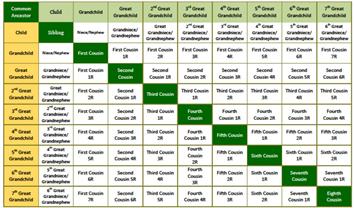
You might also like to use the chart to work through the real-life example below of second cousins and 'once removed' cousins. You start the process by finding the common ancestor of two individuals.
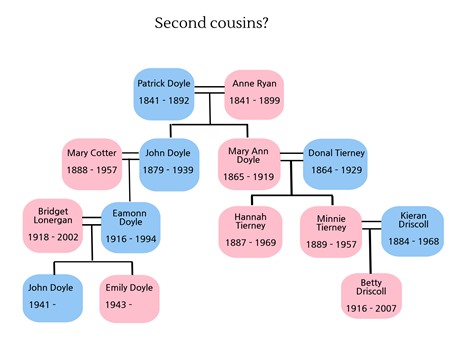
- The second cousin connection is actually quite simple: the common ancestor is a great grandparent, so, in the family tree to the left, Betty Driscoll and the John Doyle born in 1941 are second cousins because they share the same great grandparents.
- The first cousin once removed relationship is slightly more complicated: it means that the common ancestor is a grandparent to one person and a great grandfather to the other.
In the tree, Eamonn Doyle and Betty Driscoll are first cousins once removed. They were born in the same year, but there are two generations between Eamonn and Patrick Doyle, and three generations between Betty Driscoll and Patrick Doyle.
Let the family history chart do the maths
The terms 'once removed' and 'twice removed' occur when the generations between two individuals and a common ancestor are unequal in number. Fortunately, you don't have to remember a mathematical formula or learn these family relationships by heart.
Just click the image above to download and start sorting out your first and second cousins from 'removed' relationships.
When you've printed it, keep a copy handy so that you can quickly calculate the relationship between two ancestors in your family tree, or between you and one of your Irish ancestors.
Cousins: a who's who
First cousins: share the same grandparents
Second cousins: share the same great grandparents
Third cousins: share the same great great grandparents
Double first cousins are either:
1. the children of a set of brothers who married a set of sisters, or
2. the children of a brother and sister who marry another brother and sister.
'Removed' cousins:
This relationship means the two people are from different generations.
Where next?
- More free family history charts to download and print.
The Family Tree Irish Genealogy Guide
Written by the creator of Irish Genealogy Toolkit and Irish Genealogy News, 'The Family Tree Irish Genealogy Guide' is full of advice, tips and strategies to ease what can be a challenging journey.
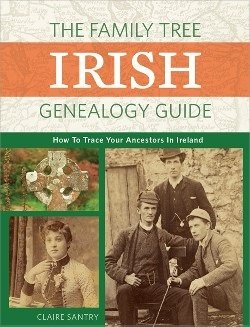
Its guidance will be useful to any researcher of Irish heritage, but especially for the target Irish-American researcher who's struggling to work back to Ireland from their immigrant ancestor.
Publisher: Penguin
ISBN: 9781440348808 / 240 pages.
Cousins:
a who's who
First cousins: share the same grandparents
Second cousins: share the same great grandparents
Third cousins: share the same great great grandparents
Double first cousins are either:
1. the children of a set of brothers who married a set of sisters, or
2. the children of a brother and sister who marry another brother and sister.
'Removed' cousins:
This relationship means the two people are from different generations.
Family tree templates
Check out my exclusive range of FREE family tree templates.
Most can be filled in on screen and then printed, ready for framing.