Religious census records and surveys

Ireland census subtitutes. Advanced genealogy research.

Religious census records are unlikely to be of much interest to the beginner family historian, but if you've already traced your Irish ancestors back through the 19th century and you know their townland or parish of origin, searching through these old parish surveys may be useful to your genealogy research.

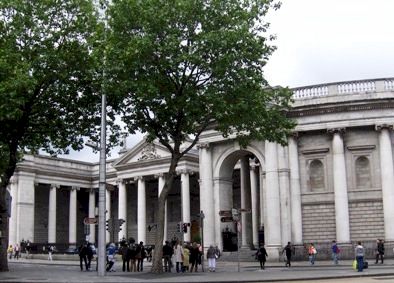
Bank of Ireland, once the Irish Houses of Parliament, Dublin.
The Religous Census of 1766 was authorised by the Irish House of Lords.
Religious census records are among the most haphasard breeds of Irish genealogy material available to us. There was no consistency in their authorisation, nor in the 'rules' of how the records were to be obtained, nor even in the type of information to be collected.

Some were carried out in just one parish on the whim of the rector. Others were carried out on a wider area, either a group of parishes or a diocese.

Only one, the Religious Census of 1766, was authorised on a national level.


The Religious Census of 1766

The only national census of this type was authorised by the Irish Parliament in March 1766. Precise reasons for its commission are lost to us, but it may have been for ecclesiastical administrative purposes or security reasons.

Political atmosphere. Although concerns about the loyalty of Roman Catholics had been on the wane for some decades, harsh Penal Laws still restricted their religious, political and economic options, and the term 'Papist' was still regarded by some as synonymous with 'Rebel'.

However, it is unlikely to be a coincidence that just two months before the authorisation, the Old Pretender (the son of the exiled Catholic King James II of England, who the Pope recognised as the legitimate king of Great Britain) died. On his death, the Pope acknowledged the ruling Protestant monarchy as legitimate. This effectively removed the threat of Rome-inspired rebellion among the Catholics of Ireland. Within just a few years, the Penal Laws began to be relaxed, and the (very) long path to Catholic Emancipation was started.

Resolution. The House of Lords resolution instructed all archbishops and bishops to direct the parish ministers of their dioceses to return a list of the families in their parishes, 'distinguishing which are Protestants and which are Papists, as also a list of the several reputed Popish priests and friars residing in their parishes.'

That was it. No further instruction about how this religious census was to be carried out, no clear advice about what information was required, and no set format for the information to be submitted.

Fulfillment. In view of the lack of clarity of how the religious census was to be carried out, there's no surprise to find that the census returns take a number of forms, including:

  • A numerical summary of Protestant families and the same for Papist families in the parish as a whole or by townland
  • Lists showing names of the heads of families, with their religion, for the parish or by townland
  • Lists showing names and religion of the heads of families, plus the number of people (including servants) of each religion in the household
  • Similar to above but broken down into landholders and tenants.
  • Any of the above but broken down into Established Church/Episcopalians, Dissenters/Presbyterians, and other smaller denominations.
  • A complete survey of all Protestants only.

What survives. Most of the original returns were lost in the fire at the Public Records Office in 1922. Surviving returns include a number for the dioceses of Armagh, Cashel & Emly, Cork & Ross, and Waterford.

Fortunately, extensive transcripts were not held at the PRO, so these have survived but they don't cover all areas. The areas best represented by surviving transcript fragments include North Cork, Limerick, Londonderry, Louth and Wicklow.

Where to view. The collection of original and transcripted returns is not held in one central depository so these are not necessarily the easiest records to access. Apart from the Arthur Tenison Groves transcripts (see below), all records are held in hard copy in Ireland.

Here are some options:

  • The mega genealogy website Ancestry has digitised about 11,000 names from transcripts created by A T Groves. These are held within the UK and Ireland collection and are available to subscribers. The records nearly all relate to parishioners in the north of Ireland. These are, as far as I'm aware, the only returns from the 1766 religious census to be available online.
  • The same 11,000 names, unindexed and arranged by parish or townland, are available on microfilm (films 100173 and 100220) through the LDS Family History Centers.
  • For details of where to find surviving returns for the whole of Ireland, download the Guide to the Religious Census of 1766 by the National Archives of Ireland (you'll need Adobe Acrobat on your computer).

Replica Macroom Castle Gateway, N22
The Religious Census of 1766 survives for Macroom in county Cork.
Records of genealogical value While the above mentioned NAI's Guide to the Religious Census of 1766 is useful, it does not differentiate between those census returns that contain material useful for genealogy research (ie names, occupations, addresses and ages) and those that provide merely statistical information.

I have, therefore, devised my own list of returns that might be of value for genealogy purposes. It is in the right hand column.

If you see one of 'your' parishes in the list, you can find out where the transcripts are held in the NAI Guide. (While I have tried to be accurate, please double check with the holding body shown in the NAI Guide, and let me know of any errors you come across.)


Other religious censuses

While the Religious Census of 1766 was the most extensive such exercise, it was not the only census carried out by the Established Church.

A 1740 Census of Protestant Householders was compiled by the collectors of the Hearth Tax. The originals were destroyed in 1922 but transcripts survive for parts of the survey in counties Armagh, Antrim, Derry, Donegal, Down, Longford and Tyrone. Hard copies are held by the Public Records Office (PRONI) in Belfast and by the National Library of Ireland in Dublin. It is not available online.

The 1749 Census of Elphin diocese was authorised by the Bishop of Elphin, Edward Synge. Nothing is known about how it was carried out, but its purpose was to discover the ratio of Protestants to Catholics in the diocese.
Considering its simple statistical aim, this religious census is wonderfully detailed. Listed by townland are the names, addresses and occupations of householders, together with the numbers and sex of all children and servants. It covers more than 50 parishes in Roscommon, 13 in Sligo and 8 in Galway.

The original is held by the National Library of Ireland in Dublin. It is also on microfilm through LDS Family History Centers, in book format through the Irish Manuscripts Commission, and online (subscription required) at Irish Origins.

Localised religious census returns Many local clergymen or bishops took it upon themselves to organise a survey from time to time. In most cases, these smaller religious census efforts were conducted only among the Protestant congregation but there are a few examples of Catholic targets ie 1792 'Leading' Catholics of Waterford, and 1824 Catholic householders of Lusmagh parish in Offaly.

You should be able to discover details, and often transcripts, too, of such censuses online. Search using the county or parish name and the term Protestant or Catholic.



Where next?

Return to the main Irish Census menu page.

More about Ireland's census substitutes.


Good for genealogy research

Surviving fragments of the 1766 Religious Census which contain names and other information relevant to genealogy research are listed below. See 'Surviving Fragments' in the main text for a fuller explanation.

  • Antrim: Ahoghill, Ballintoy.
  • Armagh: Cregaan.
  • Cavan: Protestants only in Kinawley, Lavey, Lurgan, Munterconnaught.
  • Cork: Aghabulloge, Aghada, Ardagh, Ballintemple, Ballyhay, Ballynoe, Carrigdownane, Carrigrohanebeg, Castlelyons, Castletownroche, Churchtown, Clenor, Clondrohid, Clondulane, Clonfert, Clonmeen, Clonmult, Clonpriest, Cloyne, Coole, Farahy, Garrycloyne, Glanworth, Grenagh, Ightermurragh, Imphrick, Inishcarra, Kildorrery, Kilmahon, Kilnamartry, Kilshannig, Kilworth, Knockmourne, Lisgoold, Litter, Macroney, Macroom, Magourney, Mallow, Marshalstown, Matehy, Middleton, Mogeely, Mourneabbey, Roskeen, Shandrum, St. Nathlash, Templemolaga, Whitechurch, Youghal, Rathbarry, Ringrone, Dunbulloge, Kilmichael.
  • Derry: Artrea, Desertlyn, Magherafelt, Boveagh, Comber, Drumachose, Desertmartin. Protestants only in Ballynascreen, Banagher, Donaghedy, Dungiven, Leck.
  • Donegal: Donoghmore diocese. Protestants only in Leck and Raphoe.
  • Down: Kilbroney, Seapatrick, Inch, Shankill.
  • Dublin: Crumlin, Castleknock, Taney.
  • Fermanagh: Boho, Derryvullen, Devenish, Kinawley, Rossory.
  • Kildare: Ballycommon, Clonaghlis, Kildare. Catholic housholders in Kilrush.
  • Kilkenny: Catholic householders only in Portnascully.
  • Laois: Lea.
  • Limerick: Abington, Cahircomey, Cahirelly, Carrigparson, Clonkeen, Kilkellane, Tuogh. Protestants only in Croagh, Kilscannel, Nantinan and Rathkeale.
  • Louth: Ardee, Ballymakenny, Beaulieu, Carlingford, Charlestown, Clonkeehan, Darver, Drumiskan, Kildermock, Kileshiel, Louth, Mapastown, Philipstown, ShanLIs, Smarmore, Stickallen, Tallonstown, Termonfeckin. Creggan.
  • Meath: Protestants only in Ardbraccan.
  • Tipperary: Ballingarry, Uskeane. Athassel, Ballintemple, Ballycahill, Ballygriffin, Boytonreth, Brickendown, Bruis, Clerihan, Clonbeg, Cloneen, Clonoulty, Clonbolloge, Clonpet, Colman, Cordangan, Corrogue, Cullen, Dangandargan, Drum, Dustrileague, Erry, Fethard, Gaile, Grean, Horeabbey.
  • Tyrone: Aghaloo, Artrea, Carnteel, Clonfeacle, Derryloran, Donaghendry, Drumglass, Dungannon, Kildress, Tullyniskan, Errigal Keerogue, Kildress.
  • Wexford: Protestants only in Edermine.
  • Wicklow: Ballymaslamey, Drumkay, Dunganstown, Kilpoole, Rathdrum, Rathnew.


| Home Page | Disclaimer | Contact |Sitemap|Privacy Policy|

Copyright© 2008-2012. Irish Genealogy Toolkit. Dedicated to helping YOU discover your Irish Heritage.
Return to top