- Home ›
- A - Z of Irish genealogy ›
- Irish petty sessions
Irish Petty Sessions Court Registers
Where local life, with all its squabbles and minor nuisances, was played out
Where local life, with all its squabbles and minor nuisances, was played out
The records of the Irish Petty Sessions Courts can be a great source of genealogical information and you'll be pleased to hear that your ancestors don't have to have been n'er-do-wells or hardened criminals to appear in these resources.
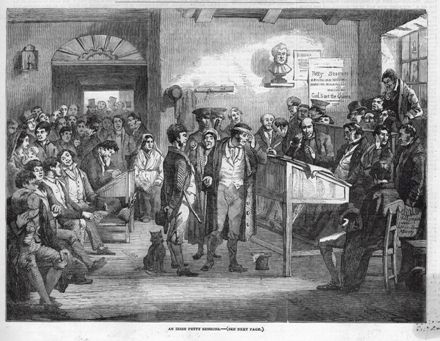
Instead, this court, while it processed more serious crimes (see below), dealt mainly with minor crimes, localised anti-social nuisances and quarrels between neighbours and families.
There's plenty of colour in these records! This is where local life was played out, with all its silly squabbles, personal tragedies and gossip.
While probably not intended in the modern sense, petty is an appropriate name for this court of law.
Some of the complaints it had to process were seriously mean-spirited or trifling, with or without the good bit of personal history that's usually attached to them.
If you come across a report of an ancestor in the books of the Irish Petty Sessions Court, you can be pretty confident of hitting upon some interesting anecdotal stuff, and possibly some details that will further your genealogy research.
What were the Irish Petty Sessions Courts?
The earliest Petty Sessions Courts were set up in the 1820s but it wasn't until 1851 that their remit was standardised by law in the Petty Sessions (Ireland) Act.
Punishment
The Irish Petty Sessions Court could impose a maximum one year's imprisonment.
Typical punishments meeted out to those found guilty were fines, a few weeks in gaol (with or without hard labour), and being bound over to keep the peace for a specified period.
Punishment
The Irish Petty Sessions Court could impose a maximum one year's imprisonment.
Typical punishments meeted out to those found guilty were fines, a few weeks in gaol (with or without hard labour), and being bound over to keep the peace for a specified period.
The island's counties were divided up into petty sessions districts, each with a number of Justices of the Peace (JPs) allocated to cover all courts within it. The county of Wicklow, for example, was divided into fourteen Petty Sessions areas, each having one prescribed day in a fortnight for the court to be held.
The office of JP was unpaid and, in practice, it was the local landowner who took on the role. Many localities established a small courthouse for the purpose of holding the Petty Sessions, but some smaller communities did not, and the court would be held wherever was deemed appropriate.
Cases were recorded by clerks, who were expected to have at least some legal experience, even if they were not formally trained in law. It is these records that make up the Irish Petty Sessions Books collections.
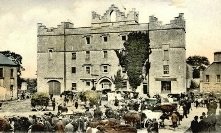 Roscommon Gaol in 1906
Roscommon Gaol in 1906Until the 1920s, the Petty Sessions were the lowest courts of Ireland, and they handled the vast bulk of legal cases, both criminal and civil. These minor cases could be brought against individuals either by government officials such as police constables or by other civilians.
When the court had no jurisdiction to hear a case ie when the case was of too serious a nature, JPs were obliged to process them, ie pass them on, to the Quarterly Sessions or the Assizes Court. In these cases, the accused was usually committed to the local gaol to await trial.
Typical cases heard at the Irish Petty Sessions Court
Drunkenness: The most common charges presented to the JP were public drunkenness and being 'drunk and disorderly'. These accounted for one-third of all cases. Yep! One in three cases.
The Temperance movement of the 19th century introduced pressure for laws to curb what many saw as the sin of drunkeness and JPs were in turn charged with administering fines as punishment.
Drunk in charge of an ass
A few cases recorded in the Irish Petty Sessions books to whet your appetite:
- Michael Downey of Athlone, Westmeath, was charged with being drunk while in charge of an ass and cart in a public area in 1910
- Pat Curley of Cloonakilla, Co Westmeath, charged with causing 'malicious injury to a bicycle' in 1908
- Five men and women were convicted of 'tippling in a sheebeen (an unlicensed premises) on Queen Street, Athlone
- Five men were charged with disturbing the Reverand J W Davidson as he was ministering a divine service in Bundoran, Co. Donegal
- John Hyland of Ballybrew, Wicklow, was charged with 'ill treating a donkey'. He was fined ten shillings and costs.
The Temperance movement of the 19th century introduced pressure for laws to curb what many saw as the sin of drunkenness and JPs were in turn charged with administering fines as punishment.
One or two shilling fines were fairly typical and considerably less than the maximum available to the JPs, but could still do considerable damage to a household's budget when full time labouring rarely brought in as much as ten shillings.
Other common offences related to
- revenue or tax (these included the use by merchants of 'light' weights and measures) which made up 21% of all cases heard in the Irish Petty Sessions Courts,
- assault (16%),
- local acts of nuisance (5%) and
- destruction of property (4%).
Local acts of nuisance included trespass, typically livestock trespass; pigs, cattle and sheep had a habit of goin' a-wandering, given half a chance, and would end up on public roads or someone's property, and often caused considerable damage to crops, grazing land and fences in the process.
Poaching (illegal hunting and fishing), cutting
and taking firewood or turf (both so essential for warmth and cooking), failing
to obtain a dog licence, and failing to maintain fences and boundaries were all
regularly set before the Bench.
Drunk in charge of an ass
A few cases recorded in the Irish Petty Sessions books to whet your appetite:
* Michael Downey of Athlone, Westmeath, was charged with being drunk while in charge of an ass and cart in a public area in 1910
* Pat Curley of Cloonakilla, Co Westmeath, charged with causing 'malicious injury to a bicycle' in 1908
* Five men and women were convicted of 'tippling in a sheebeen (an unlicensed premises) on Queen Street, Athlone
* Five men were charged with disturbing the Reverand J W Davidson as he was ministering a divine service in Bundoran, Co. Donegal
* John Hyland of Ballybrew, Wicklow, was charged with 'ill treating a donkey'. He was fined ten shillings and costs.
Where can the records of the Irish Petty Sessions
Court be studied?
Surviving Irish Petty Sessions Registers for the 26 counties of the Republic of Ireland date mostly from 1858 to 1924, although some are earlier. Most of the originals are held by the National Archives of Ireland in Dublin.
It's a huge resource, with more than 22.5million records, and it's available, fully indexed and imaged, at FindMyPast. You can see a list of the courts included in the collection, with their respective years of coverage, here.
In March 2020, Ancestry also added this collection to their database of Irish records. It is fully indexed and can be searched by name or browsed by court.

Surviving Irish Petty Sessions Registers for the 26 counties of the Republic of Ireland date mostly from 1858 to 1924, with just a few dating earlier. Nearly all the originals are held by the National Archives of Ireland (NAI) in Dublin.
It's a huge resource, with more than 22.5million records, and it's available, fully indexed and imaged, at FindMyPast as part of the Ireland and World subscription packages. You can see a list of the courts included in the collection, with their respective years of coverage, here.
The NAI's Irish Petty Sessions collection was microfilmed by FamilySearch. Images can be viewed by researchers at LDS Family History Centers.
Records also survive for the six counties now in Northern Ireland. These are held by PRONI. They have not been digitised and can only be viewed in person at PRONI's Belfast offices.
Many reports of the Petty Sessions Courts, pretty much verbatim if the story was sufficiently controversial, amusing or salacious, found their way into local newspapers. The more prosaic cases were not usually reported, except on a very light news week. But if you find an ancestor appearing as a defendent, plaintiff or witness, your next port of call should be historical Irish newspapers.



From the Nenagh Guardian,
9 December 1863
Roscrea Petty Sessions
Before J F Hutchinson (chairman), J D Hutchinson, and Sandford Palmer, Esqrs.
ROBBERY
An itinerant dealer in soft goods, who gave his name as Patt McLaughlin, was brought up on remand, charged by Constable Sullivan with having stolen a car, the property of a man named Coppinger, residing near Thurles.
The Constable, on being sworn, stated that from information he had received, he proceeded on the morning of the 30th ult. to one of the low lodging houses in Grove Street and, seeing a car answering the description of the stolen one, lying opposite the door, he threated to summon the proprietor for obstructing the local thoroughfare, when a little boy, son to the accused, ran out and stated that the car belonged to his father who was in bed.
The father was soon roused from his slumbers and taken into custody, but denied having any knowledge of the car.
The lodging housekeeper then got into the witness box, and deposed that the prisoner brought the very car in question to her house the night before the Constable came to inquire about it.
Coppinger, the owner of the car, was produced, and identified the car as his.
The Bench said there could be no doubt as to the prisoner's guilt, and sentenced him to two months' imprisonment with hard labour.
FURIOUS DRIVING
Constable Garvey summoned John Fanning for furious driving.
The constable stated that the defendant drove his horse and car furiously through the town on teh 30th ult. (the fair day), to the great danger of the public, and that a man was knocked down on the occasion, but as he was not much hurt, he declined to prosecute.
The magistrate observed that the practice was a dangerous one, but as the defendant was poor and had expressed contrition for his conduct, they would let him off with the mitigated penalty of 2s 6d and costs.
LARCENY OF POTATOES
The same constable charged Ellen Ryan, Anne Nevin and Judith Costelloe with stealing potatoes on the morning of the 2nd inst. On being sworn, he deposed that he was on duty on the morning in question and that about two o'clock he was informed the defendants had come into town from the direction of the workhouse, heavily laden with sacks of potatoes.
He immediately went to the house where they lodged and found about 12 stone of potatoes. They were wet and dirty, and evidently had only been recently taken from a pit. A sample of the potatoes was shown the Bench, and a man named Whelan appeared to prove that he had potatoes taken from his pit on the night in question, and to identify those now produced as his.
The magistrates, however, considered the identification of potatoes was very difficult, if not altogether impossible, and they therefore dismissed the case against the defendants.
This terminated the business of the day, and the court shortly afterwards rose.