- Home ›
- Irish civil registration
Irish civil registration
Birth,
marriage and death records
Irish civil registration forms the backbone of genealogical research in Ireland because birth, marriage and death records help us to identify family groups. Being 'Government' records (not church records) these Irish 'vital records' are often the most accurate documentary evidence of our ancestors' lives.
They also survive intact - and it's not often that can be said of Irish genealogy records!
The only real complication in locating Irish civil records results from the division of Ireland in 1922.
Historical resources are split between GRONI – the General Register Office of Northern Ireland – which is in Belfast, and GROIreland – the General Register Office of Ireland – which has a Research Room in Dublin for personal visitors but has its HQ in Roscommon. Contact details are at the foot of this page.
If you already know the names, approximate date and location of your ancestor's birth, marriage or death, finding these life events in Irish civil registration resources and obtaining copies of relevant certificates is relatively easy.
Accessing the Irish Civil Registration Records - Step by step
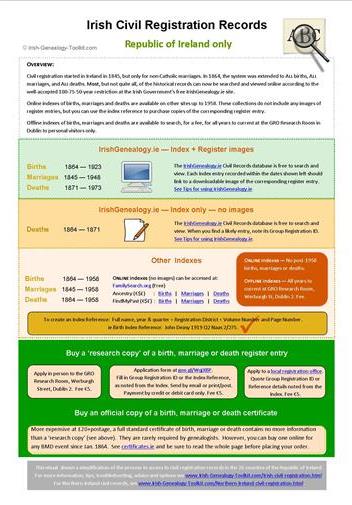
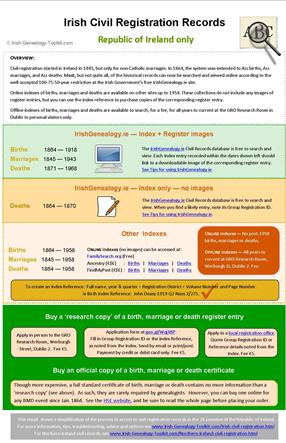
For the majority of family historians searching for their ancestors since 1845/1864, the details in the visual above (click it to download a larger view in pdf) will be sufficient to guide them to the relevant records of births, marriages and deaths. Below is a more detailed step-by-step guide.
Ancestors from Northern Ireland?
If your family came from counties Antrim, Armagh, Derry-Londonderry, Down, Fermanagh or Tyrone, see the Northern Ireland civil registration page.
Ancestors from Northern Ireland?
If your family came from counties Antrim, Armagh, Derry-Londonderry, Down, Fermanagh or Tyrone, see the Northern Ireland civil registration page.
Step 1: Dates Check the relevant dates. Irish civil registration started in 1845 with the recording of all weddings (civil and religious) EXCEPT those performed in Roman Catholic churches. From 1 January 1864, all births, ALL marriages (including those performed in Roman Catholic churches) and all deaths had to be registered.
In genealogical circles, births, marriages and deaths are known as BMDs.
If the bmd you seek dates from before 1845/1864 you will have to seek out the relevant church records.
See the Counties of Ireland pages if you're not sure whether your ancestors' county is now in the Republic of Ireland or Northern Ireland.
Step 2: Indexes You can search the ONLINE Irish civil registration indexes at the sites below:
- IrishGenealogy – Index. Free. Births to 100 years ago; Marriages to 75 years ago; Deaths to 50 years ago. (Northern Ireland counties only - records end at December 1921.)
- FamilySearch – Index to 1958 (Northern Ireland counties end 1921). Free
- Ancestry – Index to 1958 (Northern Ireland counties end 1921). Fee/subscription required
- FindMyPast – Indexes to 1958 for births, marriages and deaths. (Northern Ireland counties end 1921). Fee/subscription required.
- GRONI Family History – Pay to view Index, transcriptions or copy certificates. Births to 100 years ago. Marriages to 75 years ago. Deaths to 50 years ago. Northern Ireland counties only.
You can search the indexes OFFLINE by making personal visits to the Public Research Rooms in Dublin and Belfast (see Addresses below).
IrishGenealogy – Index. Free. Births to 100 years ago; Marriages to 75 years ago; Deaths to 50 years ago. (Northern Ireland counties end with December 1921.)
FamilySearch – Index to 1958 (Northern Ireland counties end 1921). Free
Ancestry – Index to 1958 (Northern Ireland end 1921). Fee/subscription required
FindMyPast – Indexes to 1958 for births, marriages and deaths. (Northern Ireland counties end with 1921). Fee/subscription required.
GRONI Family History – Pay to view Index, transcriptions or copy certificates. Births to 100 years ago. Marriages to 75 years ago. Deaths to 50 years ago. Northern Ireland counties only.
You can search the indexes OFFLINE by making personal visits to the Public Research Rooms in Dublin and Belfast (see Addresses below).
Step 3: Quoting the Reference Having found a registration entry of interest in the index, you create the full GRO Index Reference. Historically, this is made up of five or six elements:
- Surname
- Year of the event
- Quarter of the year in which event took place (not required for all years... see Indexes)
- SRD District/Poor Law Union where event registered
- Volume number
- Page number.
However, if you are using the IrishGenealogy.ie database, the Group Registration ID* (if provided) plus the Surname, will suffice.
*Often abbreviated to GRID.
Step 4: Copies of Register entries / Certificates Please note the following:
- Most researchers will choose to purchase a 'research copy' of the bmd certificate (ie a photocopy of the register entry) for Births, Marriages and Deaths that took place anywhere on the island up to and including 1921 or in the Republic of Ireland since 1922.
- If you know the GRO Index
reference/Group Registration ID, you can order a 'research copy' of the
bmd registration for just €5 from GRO Roscommon or any local registration office in the Republic of Ireland. There is no online purchase route, only an email service. Download an application form here and follow the instructions.
- If you don't know or don't quote the reference, you can still apply for a 'research copy' by providing as much information as possible; GRO staff will then try to identify the register entry.
- Most researchers do not need a Certified Certificate (one that is printed on secure paper and is often required for legal or administrative purposes). However, if you want or need a certified certificate, you can order one on the same application form. At April 2025, a certificate costs £20 plus postage.
Step 4: Copies of Register entries / Certificates Please note the following:
- Most researchers will choose to purchase a 'research copy' of the bmd certificate (ie a photocopy of the register entry) for Births, Marriages and Deaths that took place anywhere on the island up to and including 1921 or in the Republic of Ireland since 1922.
- If you know the GRO Index
reference/Group Registration ID, you can order a 'research
copy' of the
bmd registration for just €5 from GRO Roscommon or any local
registration office in the Republic of Ireland. There is no online
purchase route, only an email service. Download an application form here and follow the instructions.
- If you don't know or don't quote the reference, you can still apply for a 'research copy' by providing as much information as possible; GRO staff will then try to identify the register entry.
- Most researchers do not need a Certified Certificate (one that is printed on secure paper and is often required for legal or administrative purposes). However, if you want or need a certified certificate, you can order one on the same application form. At April 2025, a certificate costs £20 plus postage.
Addresses
GRO:
- General Register Office, Government Offices, Convent Road, Roscommon, Co Roscommon. Tel: +353(0)90 663 2900. No public research facilities. Email/Postal service only. See Step 4 above for more details.
- GRO Research Room, Werburgh Street, Dublin 1. Applications in person only. For a fee, the Irish civil registration index books can be searched here and 'research copies' purchased. See Indexes - Part 2 page.
GRONI:
- General Register Office of Northern Ireland, NISRA, Colby House, Stranmillis Court, Belfast BT9 5RR. Tel: 0300 200 7890 (+44 300 200 7890 if outside the UK). Personal visitors to either the GRONI public search room (need to book in advance) or the PRONI search room can view indexes/register entries covering Northern Ireland from 1845/1864 to current. Online indexes/register entries stop at 100 years ago for births, 75 years for marriages and 50 years for deaths. Find out more about GRONI on the Northern Ireland civil registration page.
PRONI:
- Public Record Office of Northern Ireland, 2 Titanic Boulevard, Belfast. Find out more about PRONI on the Northern
Ireland civil registration page (see link above).
More about the Irish civil registration records:
► Ireland's birth records and the information they contain
► Irish marriage records (civil) – often the easiest and most satisfying to discover
► How much have Irish names changed since civil registration was introduced?
► If you are looking for birth, marriage and death records dating from before the Irish civil registration system started, you'll need to search Church Records. Find out how to trace family history through Irish church records.
History and brief overview
The Irish civil registration system was introduced in April 1845 but was initially restricted to weddings held in non-Catholic churches or civil weddings held in register offices.
Only in January 1864 did it become obligatory to register births, ALL marriages, and deaths with the local authorities.
Registrations were collated by Superintendent Register Districts, now known as local registration districts, and then by county.
Some common abbreviations:
GRO – General Register Office, Dublin/Roscommon
GRONI – General Register Office Northern Ireland, Belfast
SRD= Superintendent Registrar District
PLU = Poor Law Union
BMDs= Births, marriages & deaths
See the Counties of Ireland pages if you're not sure whether your ancestors' county is north or south of the 1921 border.

Overview & brief history
Ireland's civil registration system was introduced in April 1845 but was initially restricted to non-Catholic church weddings and civil weddings held in register offices.
Only in January 1864 did it become obligatory to register all births, marriages and deaths with the local authorities.
Registrations were collated by Superintendent Register Districts, now known as local civil registration districts, and then by county.
GRO = General Register Office, Dublin and Roscommon
GRONI = General Register Office Northern Ireland, Belfast.
Addresses at bottom of page.
See the Counties of Ireland pages if you're not sure whether your ancestors' county is north or south of the 1922 border
Common abbreviations:
SRD= Superintendent Registrar District
PLU = Poor Law Union
BMDs= Births, marriages & deaths