- Home ›
- Irish Census
Irish census records date
back to 1821, but...
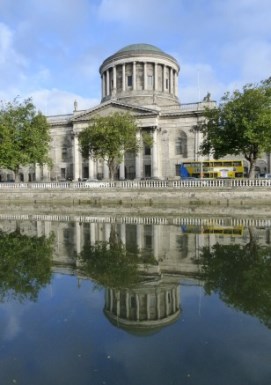 The Four Courts on the River Liffey, Dublin
The first Irish census was taken in 1813 but had so many flaws that the records were deemed useless and destroyed. A second, more successful, attempt was made in 1821 and a census was subsequently held every decade until 1911.
The first Irish census was taken in 1813 but had so many flaws that the records were deemed useless and destroyed. A second, more successful, attempt was made in 1821 and a census was subsequently held every decade until 1911.
The Four Courts building on the River Liffey, DublinThe
information contained in these records varied according to the year but
always included at least the names of all individuals, their ages and their
relationships to their head of household, plus some basic data about their land
or home.
You could reasonably expect that after such extensive record-taking (taken 20 years before all-name censuses in England, Scotland and Wales, and 30 years before the USA), ancestral search through the 19th century would be a breeze.
Sadly, that is not the case.
Irish census 1821 to 1911 - a summary
The original census records for 1861 and 1871 were destroyed shortly after they were collected, and for some inexplicable reason (possibly for something as prosaic as a need to create additional storage space), the records for 1881 to 1891 were pulped, by government order, during the First World War.
Just a few years later, in 1922, an explosion and subsequent fire at the Public Records Office in Dublin destroyed most of the four censuses taken from 1821 to 1851. Only fragments of these censuses survive.
This means that the censuses of 1901 and 1911 are the only complete sets available for your Irish ancestor search. These have now been digitised and released, free, online.
THE fire that burnt 'all' the Irish records
Many people are put off researching their Irish family history because they are told 'all the records burned' in a fire in 1922.
As always, there's a shred of truth in this.
There was a fire. And irreplaceable documents, manuscripts and other records were reduced to ashes. But get the whole story before you give up on your Irish ancestors, please.
You'll find links to more detailed webpages pages and blank transcription forms in the Related Pages menu.
You'll find links to more detailed webpages pages and blank transcription forms in the Related Pages menu.
19th-century census substitutes
Because virtually all 19th-century Irish census records were destroyed, family historians must instead rely on other genealogical sources for that period. These are collectively known as 'census substitutes'.
The most useful are land records (especially Griffith's Valuation), religious censuses, school registers, old-age pension applications and other miscellaneous lists of names such as trade directories.
Before you start looking into those alternatives, though, take a look to see if any of the fragments of Ireland's earliest censuses are worth pursuing. Their potential value will depend largely on whether or not you know your ancestors' place of origin.
THE FIRE that supposedly burnt all the Irish records
Many people are put off researching their Irish family history because they are told 'all the records burned' in a fire during the Civil War.
As is usually the case, there is a shred of truth in this.
There was a fire. And irreplaceable documents, manuscripts and other records were reduced to ashes. But get the whole story before you give up on your Irish ancestors, please.
Find out what really happened to much of Ireland's genealogical heritage on 30 June 1922.
1920s
A census wasn't taken in Ireland in 1921 due to the civil war that was raging throughout the island at that time. However, two were taken in 1926 in both north and south.
- The Irish Free State Census covered the 26 counties that was to became the Republic of Ireland. The census returns are scheduled to be released in April 2026. (It's been quite a tortuous route to this release... See the latest news about the 1926 census release.)
- The paperwork from the 1926 Census of Northern Ireland, which covered counties Antrim, Armagh, Down, Fermanagh, LondonDerry and Tyrone, was destroyed during WW2. (Unbelievable, isn't it?)
1930s
The UK's
wartime National Register was created just weeks after Britain declared war on
Germany. It was a register of the population of Northern Ireland and was a census in
all but name. (No such register was taken in the Republic of Ireland.) Gathered by address, it notes full names, dates of birth and occupation of each person living in each household, plus any previous experience of the military, police, medical professions etc.
The paperwork survives and access to it is currently controlled by Freedom of Information laws.
If you have the names and addresses of individuals living in the six
counties, you can make an FOI application, free, via PRONI's regular enquiry form.
The FOI procedure is not in the slightest difficult, so don't be put off.
More about the 1939 National Register.
Indispensable!
Irish Genealogy Guide
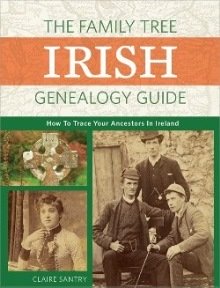 Written by the creator of Irish Genealogy Toolkit and Irish Genealogy News, 'The Family Tree Irish Genealogy Guide' is full of advice, tips and strategies to ease what can be a challenging journey. Its guidance will be useful to any researcher of Irish heritage, but especially for the target Irish-American researcher who's struggling to work back to Ireland from their immigrant ancestor.
Publisher: Penguin. ISBN:9781440348808/240pgs.
Click/tap image for details
Written by the creator of Irish Genealogy Toolkit and Irish Genealogy News, 'The Family Tree Irish Genealogy Guide' is full of advice, tips and strategies to ease what can be a challenging journey. Its guidance will be useful to any researcher of Irish heritage, but especially for the target Irish-American researcher who's struggling to work back to Ireland from their immigrant ancestor.
Publisher: Penguin. ISBN:9781440348808/240pgs.
Click/tap image for details

Free Census Forms
When carrying out genealogy research using the 1901 census, transcribe all the details about your ancestors into these free blank census forms.